




What Remains Unresolved in a Just Peace: Key Insights from a Discussion with Hrair Balian
As negotiations between Armenia and Azerbaijan continue to evolve, a key question remains unresolved: can peace be achieved without justice?
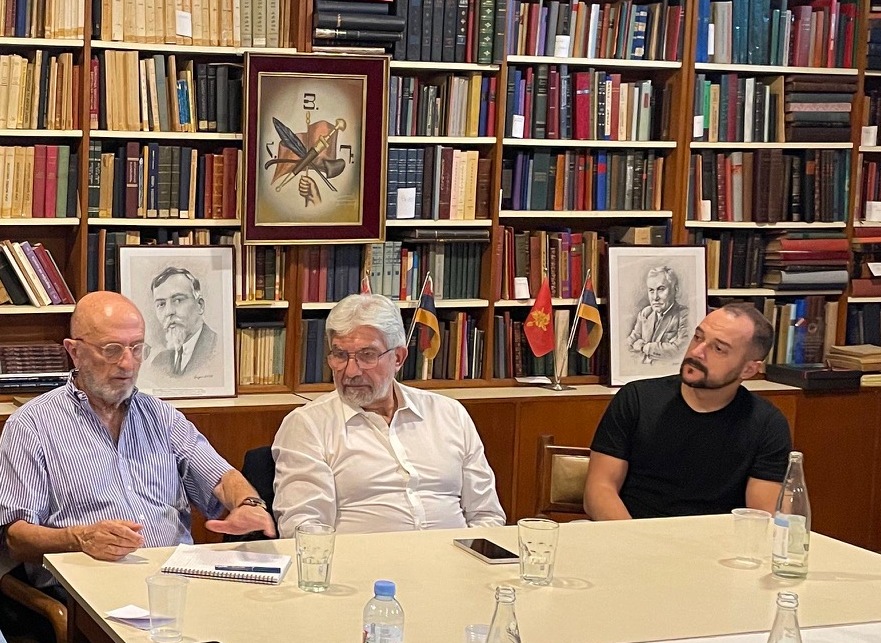
That question framed a public discussion titled “Is a Just Peace Possible in the Caucasus?”, held on December 18 at the Daghlian Library of the Armenian Cultural Association. The event was organized by the Armenian National Council of South America and featured international conflict-resolution expert Hrair Balian, a senior figure affiliated with the Carter Center.
The discussion was moderated by Khatchik DerGhougassian, who provided political context, structured the exchange, and connected the regional, international, and domestic dimensions shaping the South Caucasus conflict. Participants included community leaders, political figures, and members of the public seeking to assess both the negotiation process and the future of Artsakh amid heightened geopolitical tensions.
Drawing on more than 35 years of experience in conflict resolution, negotiations, and human rights—across the Balkans, Eastern Europe, the Caucasus, Central Asia, the Middle East, and Africa—Balian offered a measured but critical assessment of recent diplomatic developments. He focused in particular on the tripartite declaration initialed on August 8 in Washington by U.S. President Donald Trump, Azerbaijani President Ilham Aliyev, and Armenian Prime Minister Nikol Pashinyan.
According to Balian, the document represents an important political signal but does not constitute a peace agreement and carries no legal force. “It opens a new phase,” he noted, “but one that must be approached with caution.”
A central argument of Balian’s presentation was that sustainable peace is impossible without addressing core issues of justice. He identified four key points that, in his view, remain absent or insufficiently addressed in the current negotiation framework.
The first is the release of 23 Armenian prisoners of war and civilians currently held in Azerbaijani prisons.
The second concerns the right of return for displaced populations, which Balian described as an imprescriptible right, regardless of the time elapsed since displacement. This applies not only to Armenians from Artsakh (Nagorno-Karabakh), but also to other communities forcibly displaced in previous decades.
The third issue is the clear delimitation of the international border between Armenia and Azerbaijan. Balian noted that Azerbaijani forces currently occupy approximately 240 square kilometers of internationally recognized Armenian territory, much of it in strategically elevated areas.
The fourth point involves the withdrawal of reciprocal legal claims in international courts. While acknowledging the controversy of such a step, Balian argued that it can be a pragmatic component of peace processes—while stressing that the legitimacy of Armenian claims is not comparable to those advanced by Azerbaijan.
Balian also addressed the so-called Trump Route for International Peace and Prosperity (TRIPP), describing it as a political and logistical advance. However, he warned of a critical uncertainty: who will guarantee its continuity and enforcement after the end of the current U.S. presidential term. In this context, he highlighted as a positive development Armenia’s insistence that sovereignty, customs and migration controls, and security along the route remain under Armenian jurisdiction.
He further noted that the initiative is linked to the Middle Corridor (Trans-Caspian International Transport Route), increasing its strategic relevance for Western actors, particularly the United States. At the same time, he did not rule out the possibility that broader negotiations between Washington and Moscow over regional spheres of influence could shape its future.
Reflecting on the causes of the 2020 war and the subsequent collapse of Artsakh, Balian pointed to Armenia’s excessive reliance on Russia in previous years. When Moscow’s strategic priorities shifted—particularly regarding energy cooperation with Azerbaijan—Armenia’s position weakened significantly. He also highlighted long-term structural challenges, including demographic decline and the depopulation of vulnerable border regions.
On Armenia’s domestic political landscape, Balian suggested that Prime Minister Pashinyan could secure another electoral victory in June, largely due to the fragmentation of the opposition. He argued that the only credible alternative would be the emergence of a unified opposition front, something that had not yet materialized at the time of the discussion.
Beyond specific policy points, one broader warning resonated throughout the conversation: the lack of internal unity. Without stating it explicitly, Balian implied that while Armenia and its diaspora remain absorbed in internal disputes, Turkey and Azerbaijan continue to pursue a clear, coherent, and long-term strategy.